
Larimer County Criminal Court Cases
Colorado's Eighth Judicial District covers Larimer and Jackson Counties. Within Larimer County, District Court hears felony cases. County Court hears misdemeanor and traffic cases. Municipal courts in Fort Collins, Loveland, and Windsor keep files for alleged city-code and municipal traffic violations. The arresting agency does not decide which court owns the final case file. Prosecutors decide what to file, and filed charges may differ from those recorded at booking.
The Combined Courts clerk is the custodian for official District and County Court records. The clerk can supply complaints, registers of action, disposition and sentence orders, protection orders, tickets, and certified copies. A register of action, often shortened to ROA, is a brief case history that can include charges, sentences, and minute orders. Sheriff records may document an arrest, but they do not replace an official Larimer County court disposition.
Larimer Criminal Court Counters Compared
Larimer County has two core state-court access points. The Larimer County Justice Center at 201 LaPorte Avenue, Suite 100, Fort Collins, houses the main clerk on the first floor. Its public building hours are weekdays from 7:30 a.m. to 5 p.m.; the clerk counter closes at 4:30 p.m. Call 970-494-3500, email 08RecordRequest@judicial.state.co.us, or fax 970-494-3580.
Loveland County Court is at 810 East 10th Street, Suite 110, Loveland. It opens weekdays from 8 a.m. to noon and 1 to 5 p.m. The phone is 970-622-2100, fax is 970-622-2149, and record email is 08RecordsRequest@judicial.state.co.us. That building also contains city police and Municipal Court offices. Those counters remain separate custodians even under one roof, so identify whether the matter is a city case or a Colorado County Court case before requesting it.
Searching Larimer County Case Records
The free Colorado Judicial Branch Docket Search is the first locating tool. It provides schedule and docket-level information, not the complete Larimer County criminal case record. A date or date range plus another filter is required. Use a known case number when possible; otherwise combine the Eighth Judicial District, Larimer County, courthouse, court type, and party name.
- Choose Larimer County and the correct courthouse, then select County or District Court.
- Set a date range, which the tool requires, and add a party name or case number.
- Review the case class, division, hearing date, and judicial officer for a likely match.
- Record the full case number and ask the filing clerk for the ROA or named documents.
- Request a certified disposition when proof of the final outcome is needed.
| Field | Type | Use |
|---|---|---|
| Judicial District | Dropdown | Select the Eighth Judicial District. |
| County and Courthouse | Dropdowns | Choose Larimer and the Fort Collins or Loveland location. |
| Court Type | Dropdown | Search County, District, or both. |
| Date Range | Dropdown or date | Required; choices run from today through six months or a specific date. |
| Case Number | Segmented text | Uses year, case class, and sequence. |
| Party or Attorney | Choice and text | Search a person, business, attorney name, or bar number. |
The official docket interface shows how the filters are organized. View the state source for this search screen before relying on a saved set of instructions.

The screen reinforces a key limit: locating a hearing is only the first step toward an official Larimer County case file.
Requesting Larimer Criminal Case Documents
The Judicial Record and Document Request asks for requester contact information, county, case number if known, the primary party's date of birth if known, party names, and other identifying facts. Criminal document choices include the Complaint or Information, Disposition or Sentence Order, Protection Order, Ticket, and ROA. Certification or exemplification can also be selected. Describe the item precisely because a docket printout and a filed order answer different questions.
Current researched fees are $0.25 per page, $5 for a name search, $20 for a certified or exemplified document, and $25 for a transcript of judgment. Research and redaction cost $30 per hour in 15-minute units after the first hour. Off-site retrieval is charged at actual cost. The court assesses the request before delivery, so do not assume the final price from page count alone.
The official form makes those document choices visible. Consult the Judicial Branch request source for its current version.
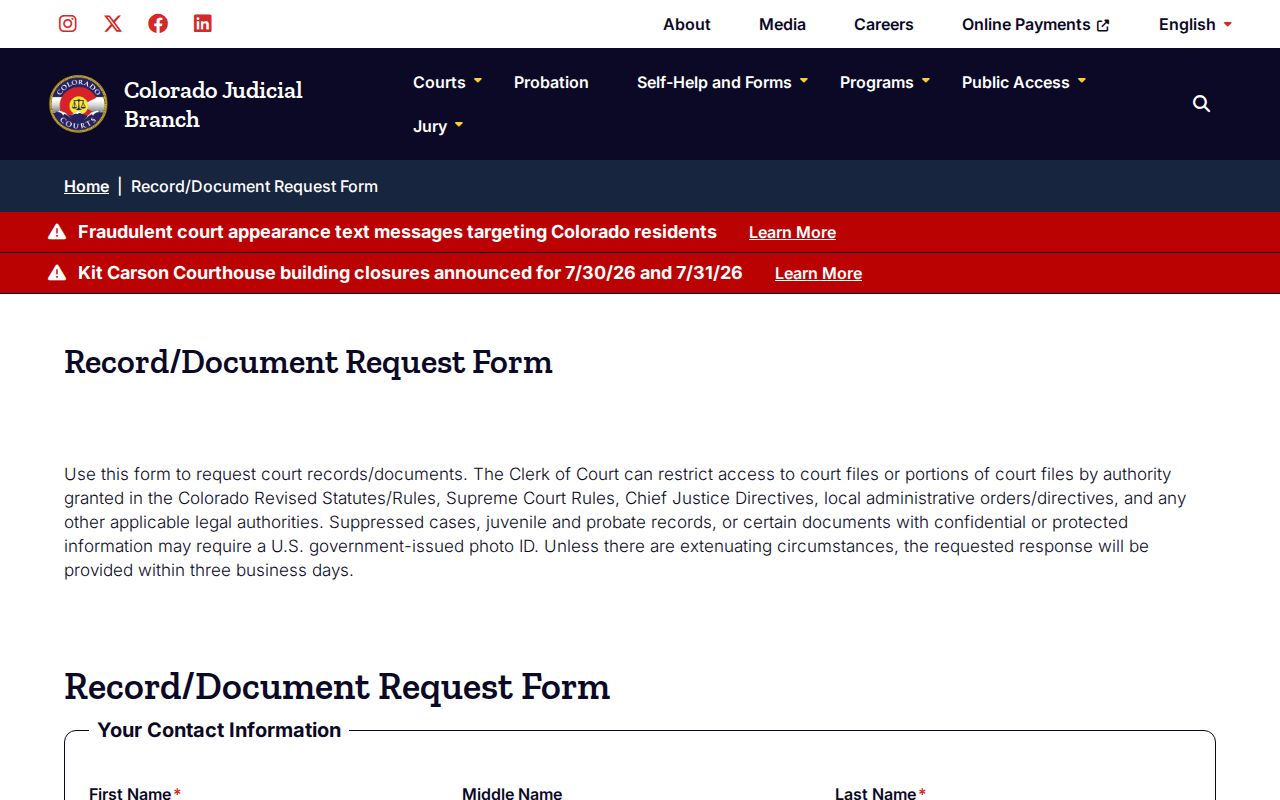
Using the exact case number and document name helps the Larimer clerk distinguish a quick copy request from broader research.
Inside a Larimer County Case File
A Larimer County court register can show the case number and class, parties, charges, events, hearings, and disposition. The free docket tool is narrower. It generally supplies schedule-level details such as court, division, hearing date, hearing type, and judicial officer. Filed documents must come from the clerk, and protected personal data may be redacted.
| Case number and court | Identifies the filing year, case class, sequence, county, courthouse, and division. |
|---|---|
| Charging document | The complaint or information states the charges prosecutors actually filed. |
| Docket entries | The ROA summarizes filings, minute orders, hearings, and other events. |
| Hearing details | Date, time, type, courtroom or division, and judicial officer may appear. |
| Disposition and judgment | An official order records dismissal, acquittal, plea, or other resolved outcome. |
| Sentence and conditions | A sentence order records the court's terms when a conviction results. |
A booking charge can be amended, dismissed, or replaced. Read the filed charging paper and final order together instead of treating the first accusation as the case outcome.
Larimer Criminal Docket Classes
The Colorado search includes case-class codes such as CR, M, and T alongside other civil, domestic, juvenile, probate, and specialty classes. A code is a filing category, not a verdict. Pair it with the court type and charging document. District Court felony matters and County Court misdemeanor matters may share criminal language while following different divisions and case-number patterns.
If a name search produces many results, the courthouse, filing year, hearing date, and full segmented number help separate cases. Do not infer an offense merely from a class code. The complaint states the filed allegations, while the disposition order states how the court resolved them.
How a Larimer Criminal Case Moves
An agency may first record an arrest, but the court case begins when prosecutors file charges. Arraignment gives the accused the charge and plea setting. Pretrial work can include motions, discovery, negotiation, and hearings. The matter may resolve through a plea, dismissal, or trial. A disposition records the result, and sentencing follows when required. The Larimer County docket may show events in this path, while the underlying motions and orders require a clerk request.
Case flow: Charges Filed › Arraignment › Pretrial › Plea or Trial › Disposition › Sentencing
Larimer DA Discovery or Court File
DA discovery and the clerk's court file are not the same product. The Eighth Judicial District Attorney handles police materials for active charged felony, misdemeanor, and DUI matters routed under Larimer's post-December 1, 2019 rule. Discovery can include evidence supplied for the prosecution. The clerk file instead contains what was filed with the court, such as the complaint, motions, minute orders, and disposition.
First determine whether the request concerns evidence or the official court record. The Larimer DA discovery page gives its request rules and fees.
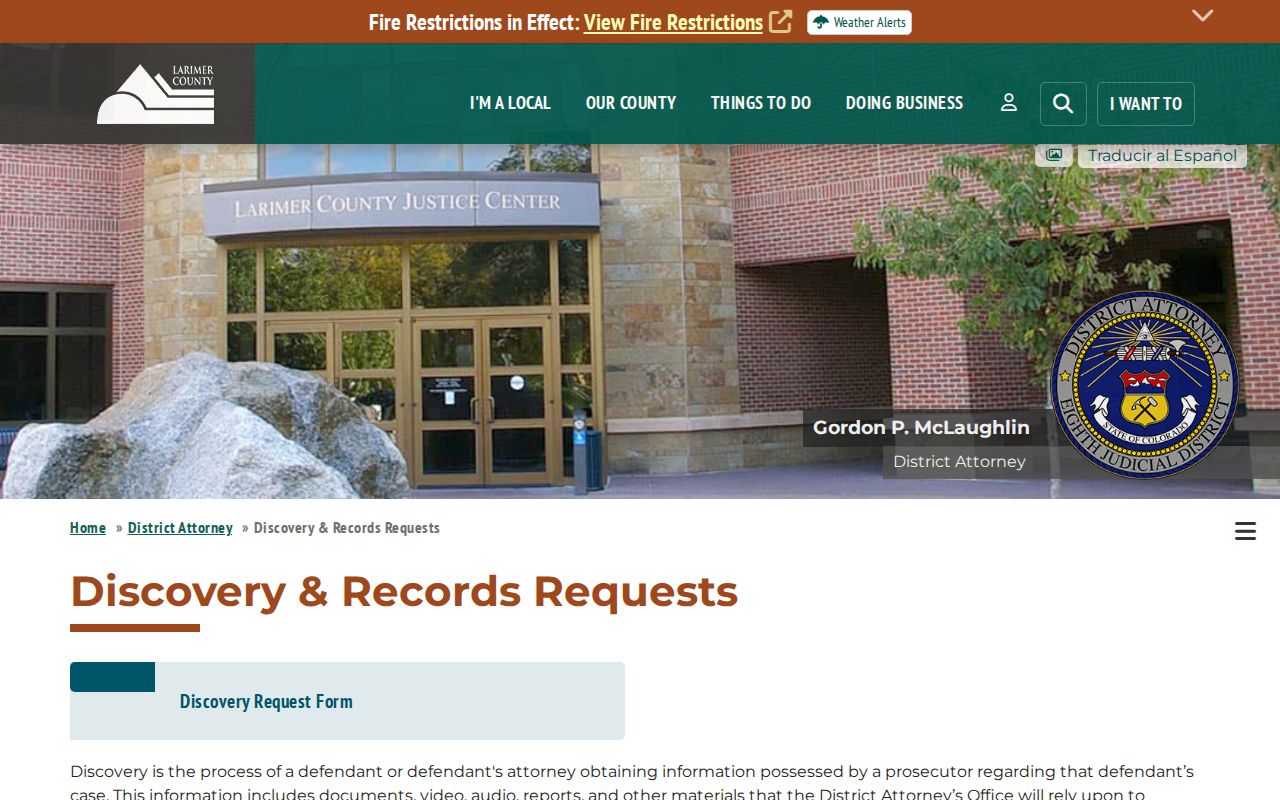
The separate route prevents a common wrong-counter problem: the DA does not certify the clerk's disposition, and the clerk does not serve as the police evidence unit.
Fixing Unknown Larimer Case Outcomes
CBI warns that Colorado repository history may show an unknown disposition when outcome reporting is incomplete. Obtain an official Larimer County disposition from the filing clerk, compare the identifiers and charge cycle, and follow CBI's correction instructions with the supporting document. A jail entry cannot fix the gap because it reports custody and booking facts, not the final judicial result.
A certified order is the strongest source when systems disagree. The broader Larimer County criminal history overview explains how court, jail, and CBI products fit together, but the clerk remains the source for proof of a case outcome.
Case Record Access and Restrictions
Colorado court access is governed by CJD 05-01, while criminal justice records also operate within the Colorado Criminal Justice Records Act. Confidential, suppressed, juvenile, sealed, and protected records may be omitted from public tools or require identification, legal authority, or a court order. Social Security numbers, financial identifiers, victim details, minor information, and other protected data can be redacted.
A blank Larimer County search is inconclusive. Check spelling, date range, courthouse, and whether the matter is municipal rather than County or District Court. Then contact the proper clerk. Ask whether the case is suppressed, sealed, archived, or simply outside the free docket tool's scope. The Judicial Branch lists paid electronic-data vendors, but warns their data is provided as is, may omit cases, and is not the official court record. Only the clerk supplies filed copies and certified orders.